
Forbes Italia dedicates its cover to Deanna Comellini and her work as designer and art director of G.T.DESIGN
50 years of innovation in Made in Italy luxury rugs design featured on Forbes
Forbes Italia dedicates a special cover story to G.T.DESIGN in the Forbes Small Giants edition now available at newsstands, celebrating the most innovative small businesses that have marked change in the Italian landscape through their work. The company led by Deanna Comellini, already recognized in 2022 among the 100 most influential women in Italy by Forbes, once again graces the pages of the prestigious magazine for its ability to redefine contemporary luxury in the textile sector.
Read the full article:
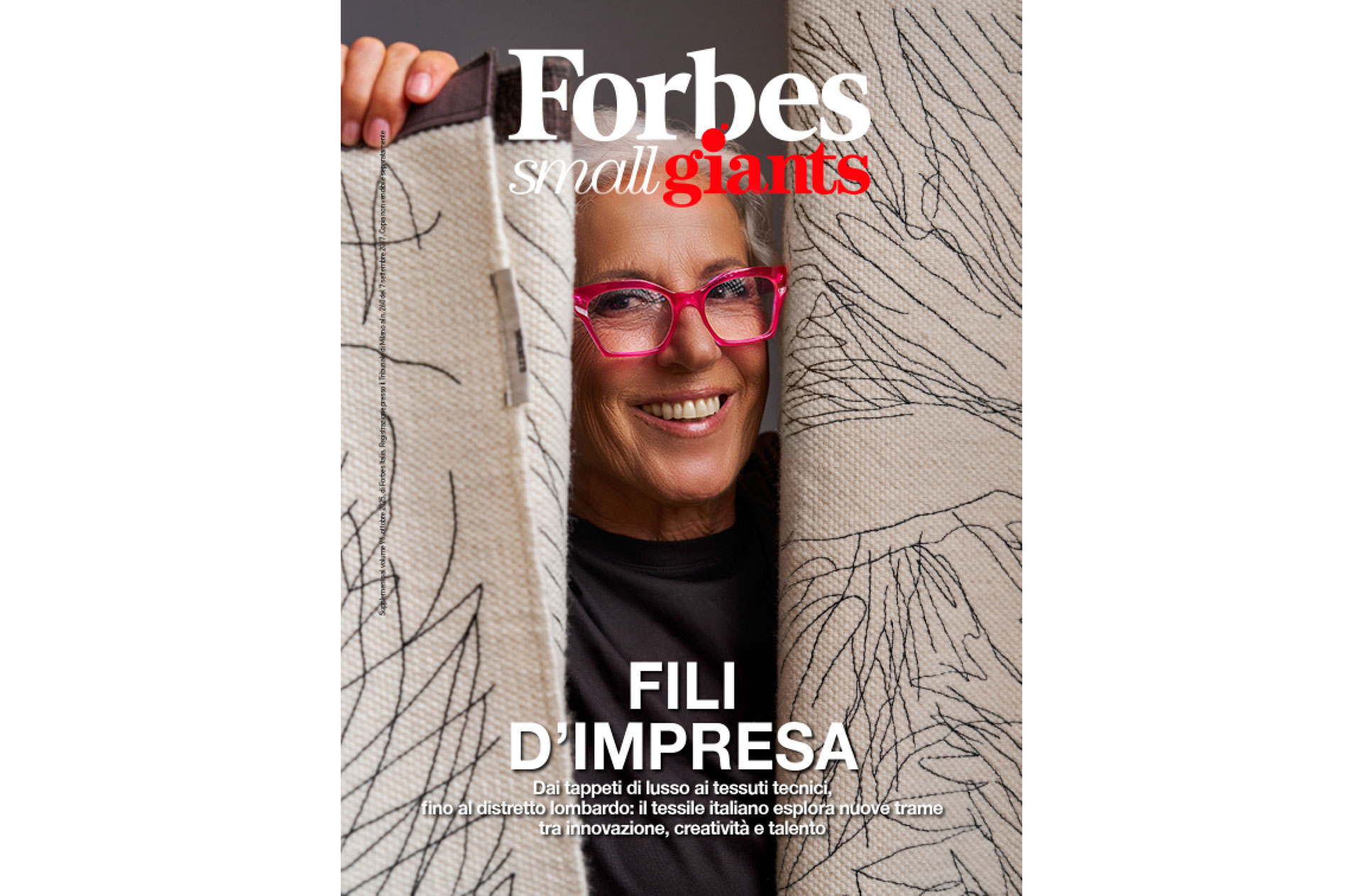
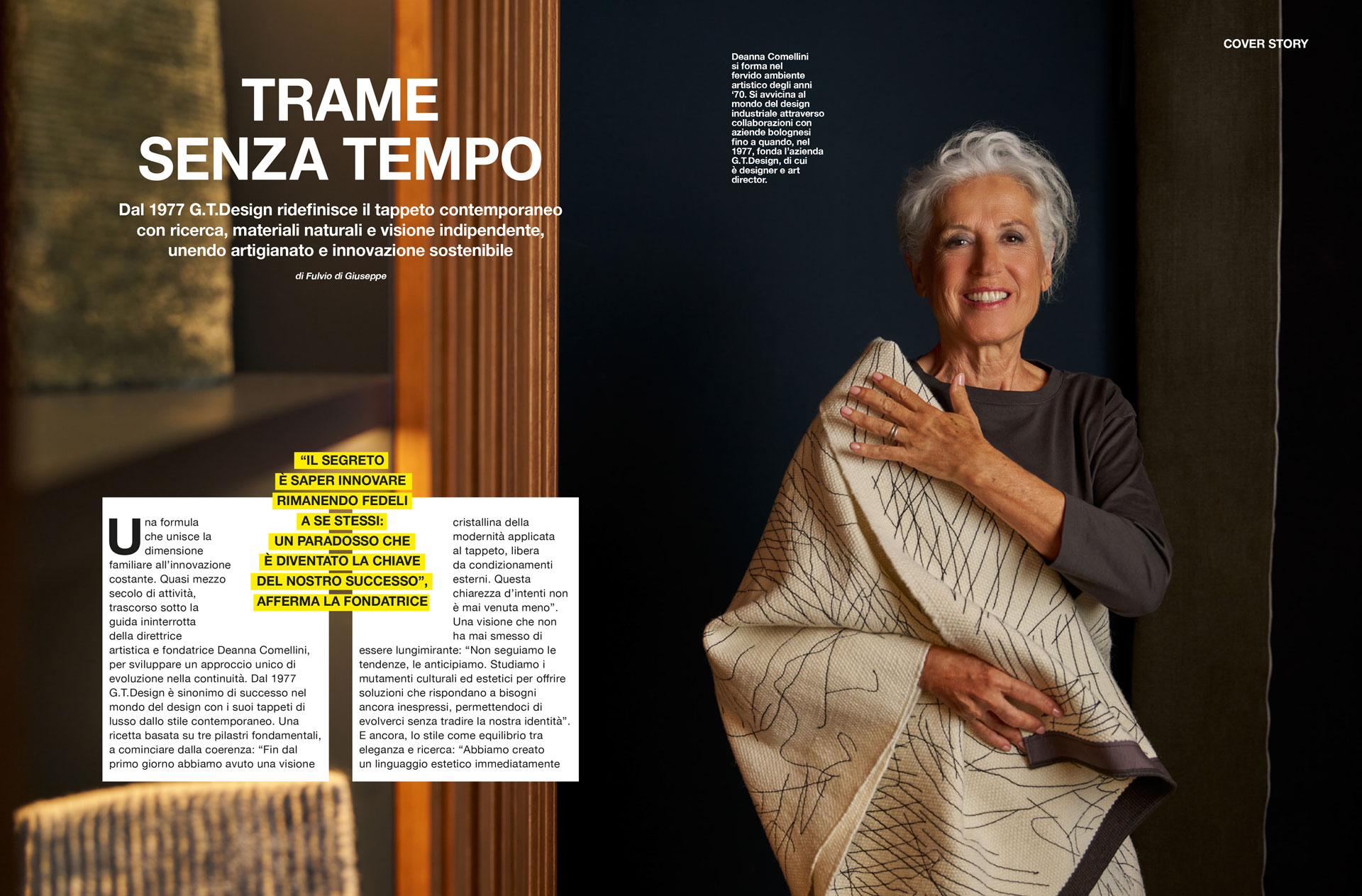
From luxury rugs to technical fabrics, to the Milanese Design District: Italian textiles explore new patterns through innovation, creativity, and talent
The article by Fulvio di Giuseppe explores how female entrepreneurs are leading the transformation of Made in Italy, advancing projects that combine artisanal tradition with futuristic vision. Among the women entrepreneurs featured in the Forbes special, the story of G.T.DESIGN emerges strongly as a virtuous example of how important women in the Italian entrepreneurial landscape are redrawing the boundaries of sustainable innovation.
The publication in Forbes Small Giants represents further recognition for those famous Italian women who, with determination and creativity, are writing new chapters of success in the country’s economy, bringing Italian excellence to the most demanding global markets.
Forbes Italia tells the story of G.T.DESIGN: timeless patterns since 1977
The company founded in 1977 by Deanna Comellini has built nearly half a century of success through a formula that combines family dimension with continuous renewal. The founder’s uninterrupted artistic direction has enabled the development of a distinctive method based on evolution in continuity, making G.T.DESIGN an international reference in the high-end contemporary rugs segment.

Deanna Comellini, La Cabina showroom Milano (photo Tommaso Cimarelli)
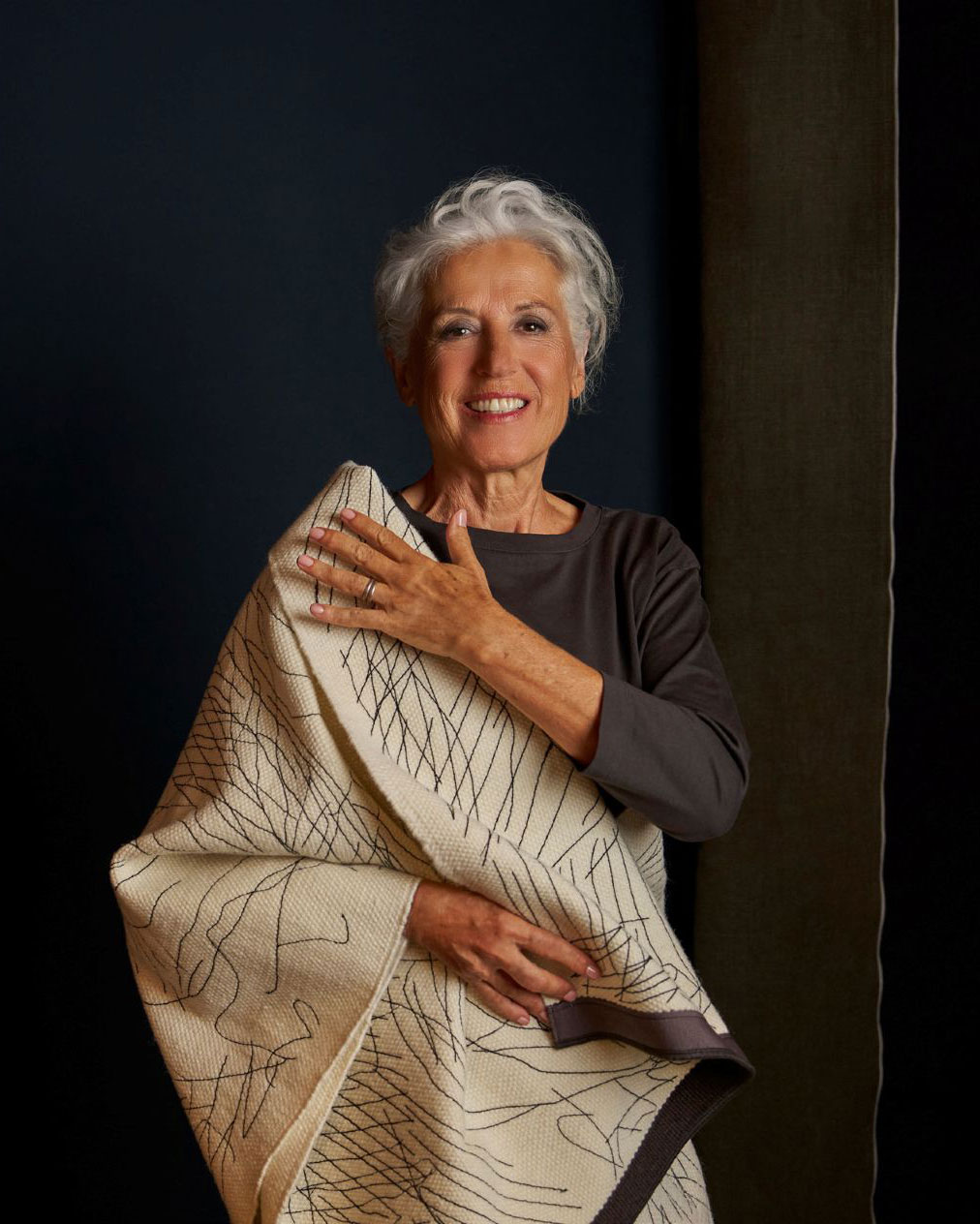
Deanna Comellini, La Cabina showroom Milano (photo Tommaso Cimarelli)
Strategic pillars
Three strategic pillars define the company’s approach.
The first is consistency: from the beginning, the company has maintained a clear vision of modernity applied to the world of designer rugs, free from external influences. This design firmness has never wavered over time.
The second element is anticipatory capacity: rather than following trends, G.T.DESIGN precedes them, analyzing cultural and aesthetic changes to propose solutions to still-latent needs. This attitude allows evolution without compromising original identity.
The third pillar concerns style understood as a synthesis between elegance and experimentation: the company has developed an immediately recognizable aesthetic code, where formal clarity merges with the sensory and tactile dimension of the product. This combination of rigor and sensitivity has generated a distinctive and lasting identity.
A free approach to design
Creative freedom and independence characterize the company's DNA. G.T.DESIGN's strength lies in refusing predefined schemes, commercial stereotypes, and mass trends. This independence of thought fuels constantly innovative production, maintaining an authentic and personal approach.
Color ranges represent one of the most characteristic elements: instead of following seasonal palettes, the company develops tones that emerge from its own aesthetic research and deep understanding of materials. Each shade is studied to enhance the intrinsic properties of the natural fibers used.
Precious materials
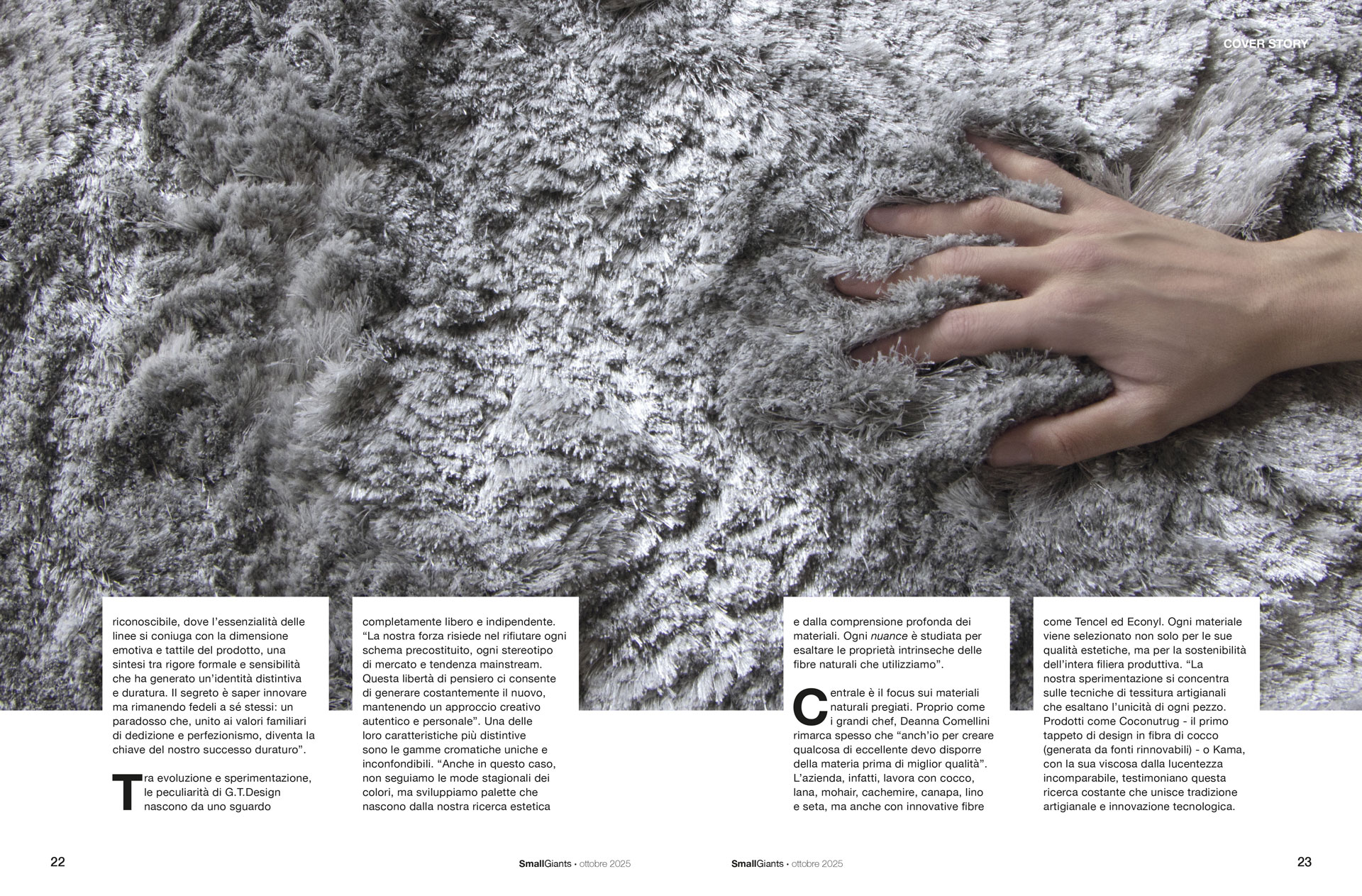
Precious natural and technical materials constitute the heart of production. As the designer emphasizes, “to create an excellent dish, it is essential to have the highest quality raw materials.” The company works with natural materials such as wool, cashmere, linen, silk, hemp, and others, also integrating innovative fibers like Tencel and Econyl. Selection considers not only aesthetic qualities but the sustainability of the entire production chain.
Experimentation focuses on artisanal weaving techniques that enhance the uniqueness of each piece. Emblematic products like Coconutrug – the first designer rug in coconut fiber from renewable sources – or Kama, with its viscose of incomparable luminosity, testify to this constant research that unites artisanal knowledge and technological innovation.
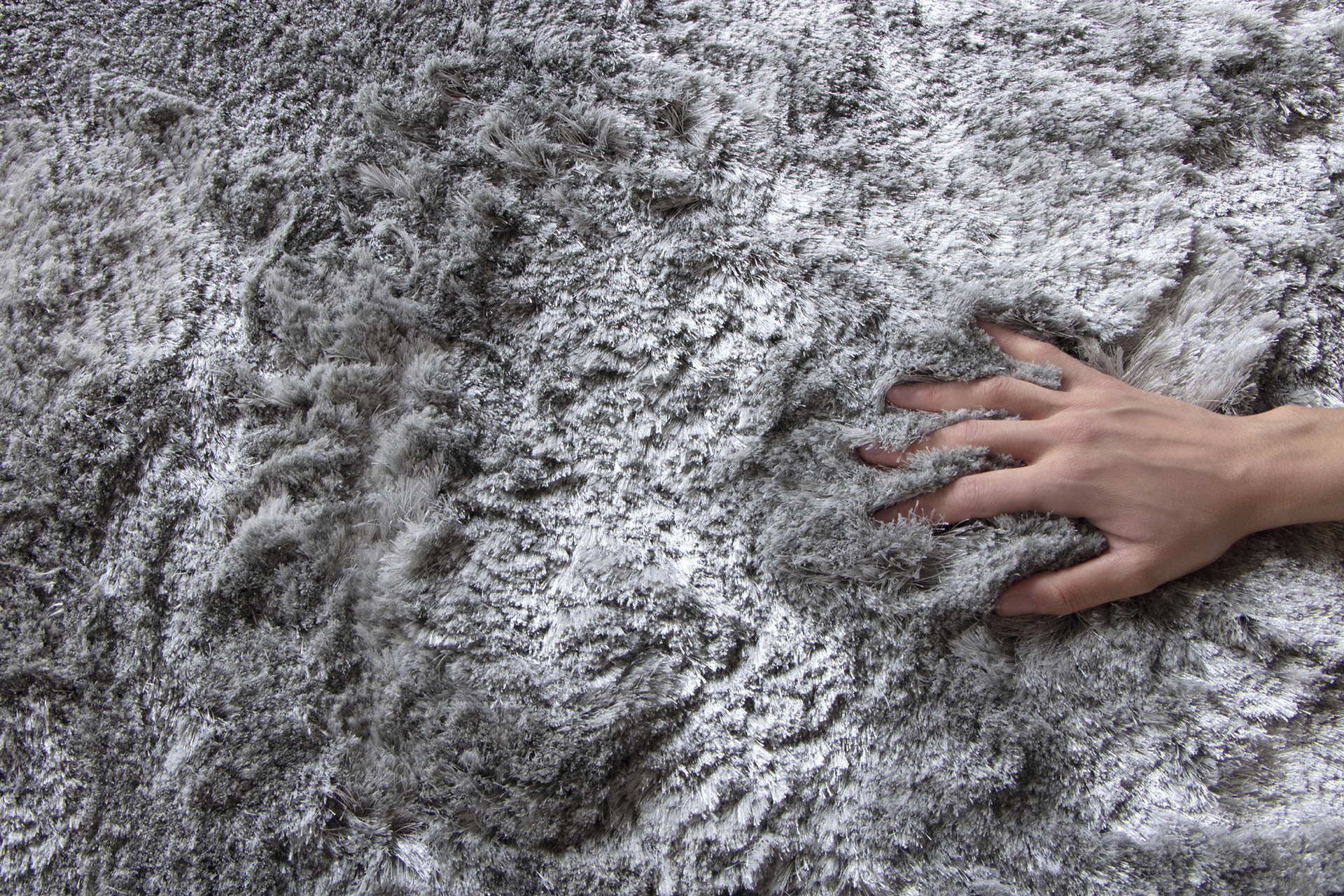
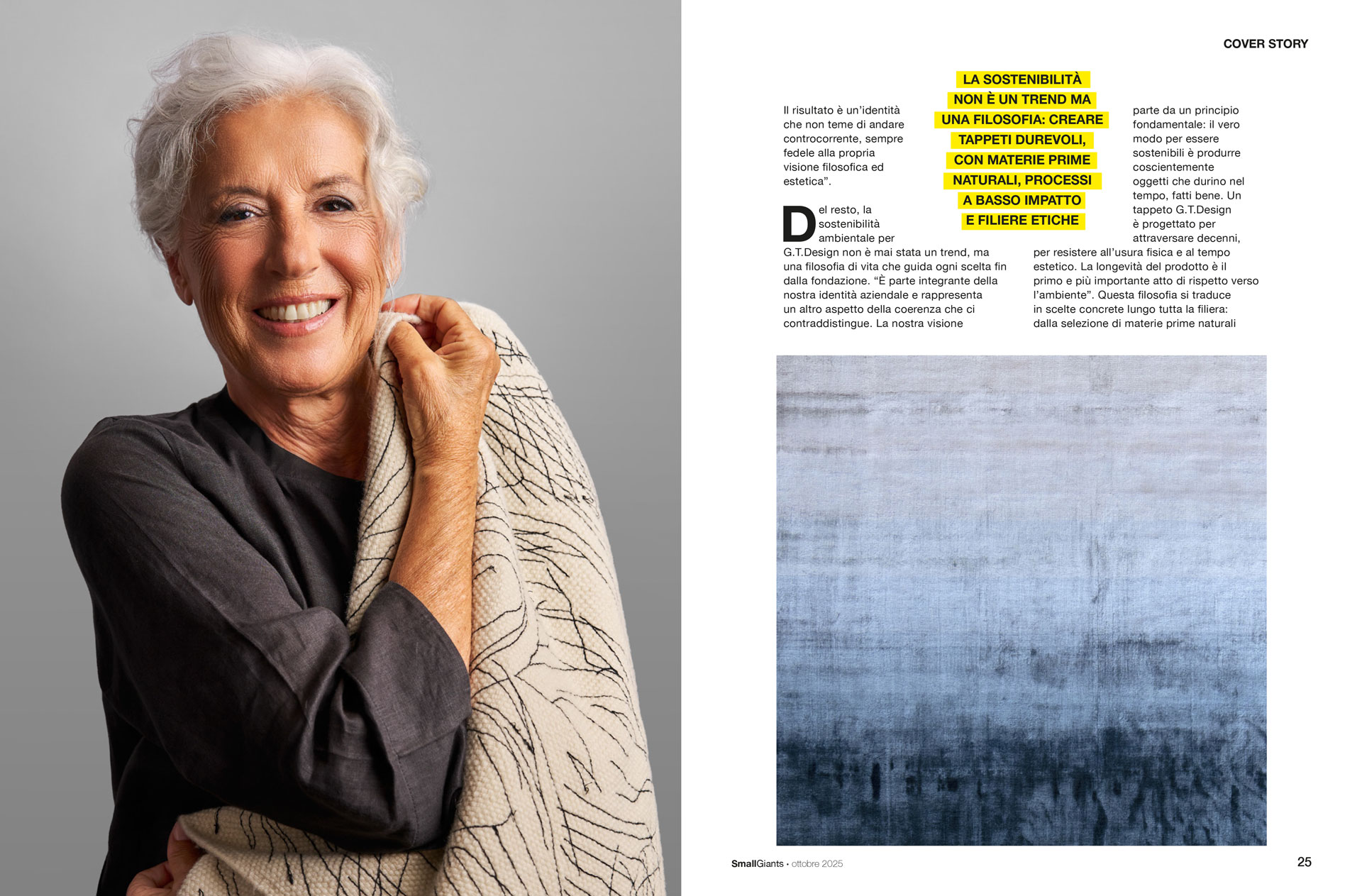
Le Materie Sottile rug, in color Ghiaccio
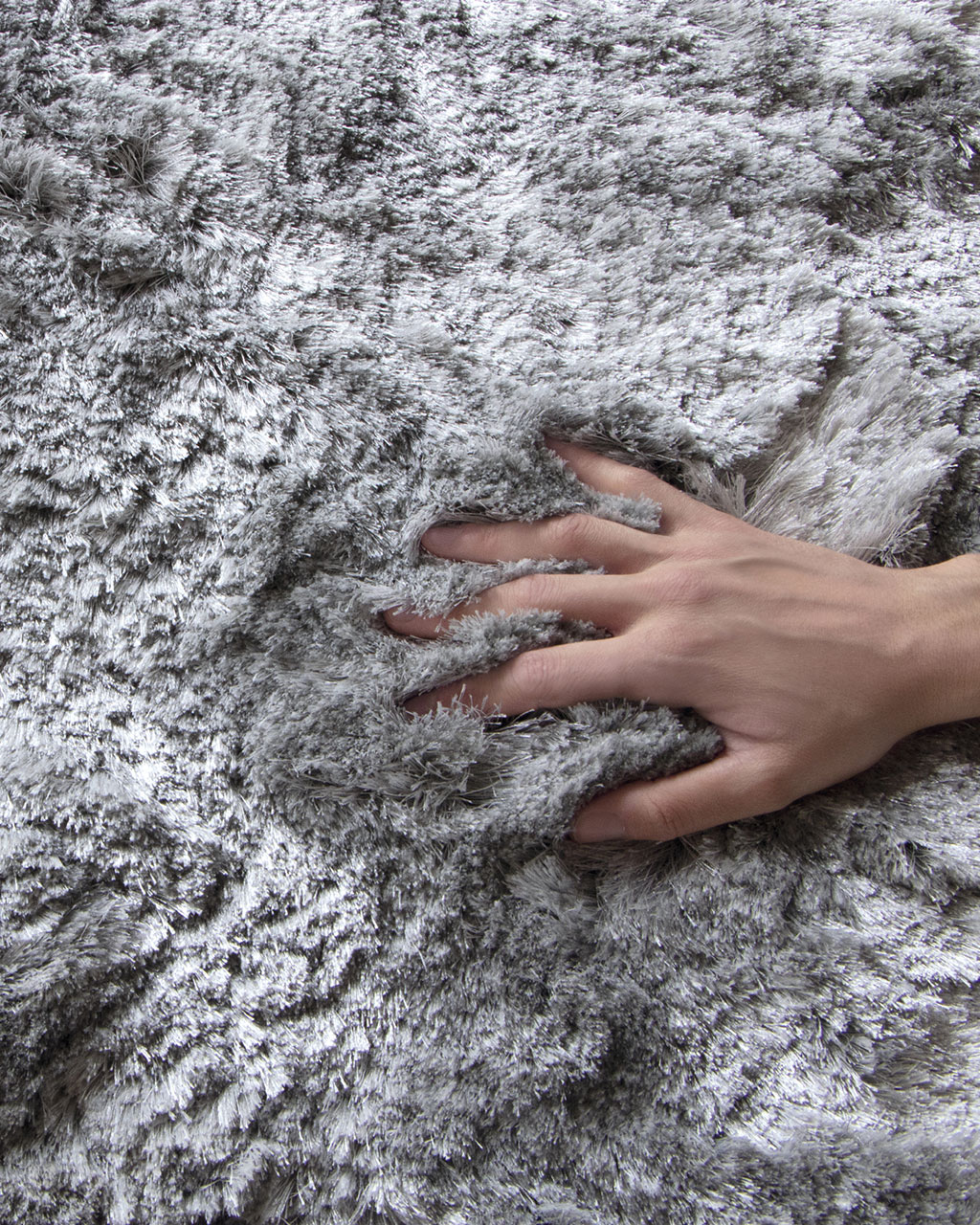
Le Materie Sottile rug, in color Ghiaccio
Sustainability
Environmental sustainability not as a trend but as a founding philosophy: this principle guides every company choice from its inception. The vision starts from a fundamental concept: the true way to be sustainable is to consciously produce objects destined to last, crafted with mastery. A G.T.DESIGN luxury rug is designed to span decades, resisting physical wear and changing taste. Product longevity represents the first act of respect toward the environment.
This philosophy translates into concrete choices throughout the entire supply chain: from selecting natural raw materials and low-impact processes, to using non-toxic dyes and completely recyclable packaging (a practice adopted since the 1970s). The company monitors the entire product life cycle according to the principle of no waste, favoring supply chains that limit water consumption and CO2 emissions.
The Contemporary Rug Manifesto
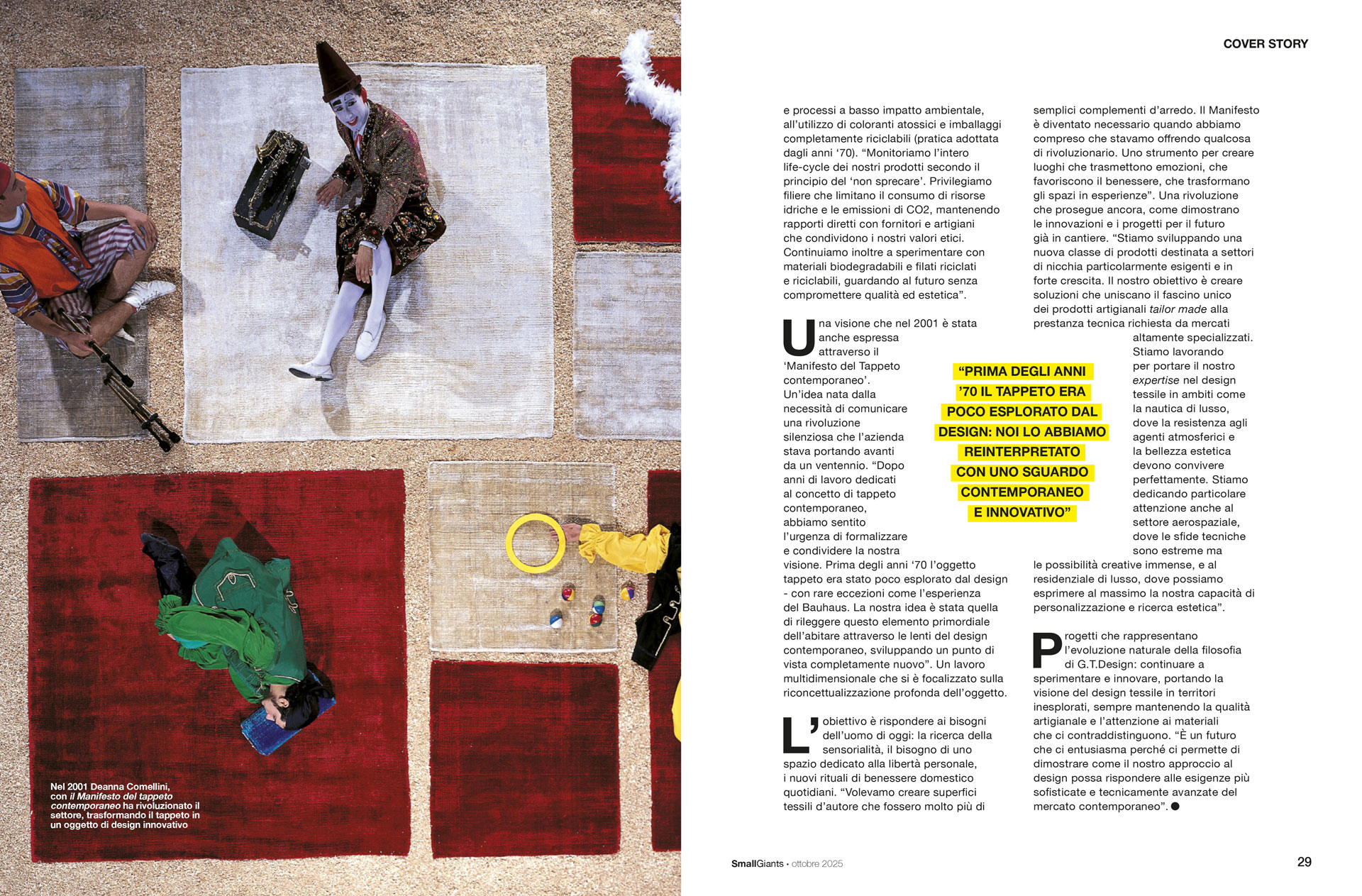
The Contemporary Rug Manifesto, presented in 2001, formalized a silent revolution carried out for two decades. Before the 1970s, modern rugs had been little explored by design, with rare exceptions like the Bauhaus experience. The idea was to reinterpret this primordial element of living through the lens of contemporary design, developing a completely new perspective.
A multidimensional work focused on the profound reconceptualization of the object, to respond to the needs of contemporary people: the search for sensoriality, the need for a space dedicated to personal freedom, new daily domestic wellness rituals. The goal was to create designer textile surfaces that were much more than simple furnishing accessories—tools to generate environments that transmit emotions and transform spaces into experiences.
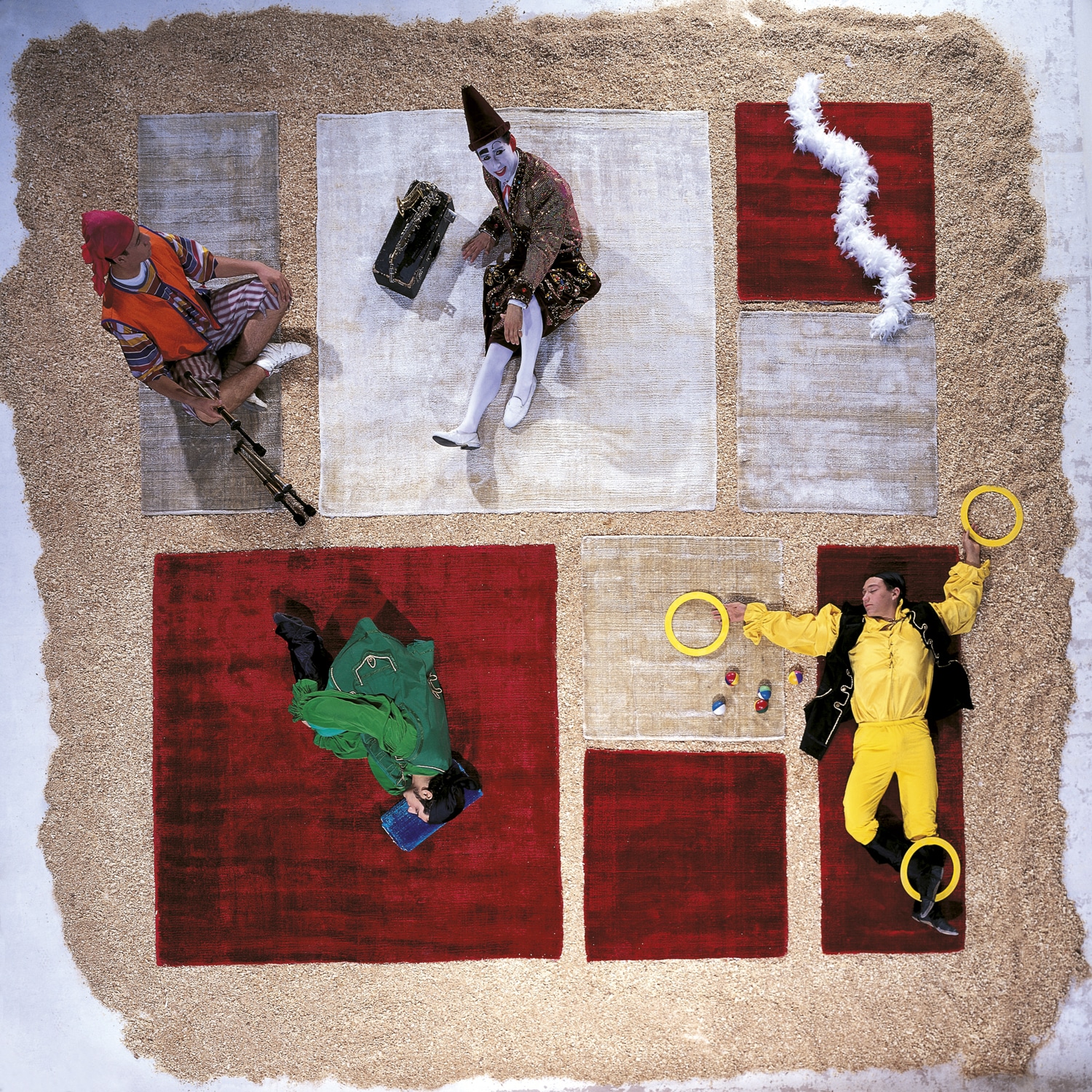
Manifesto of the Contemporary Rug (photo Piero Casadei)
Manifesto of the Contemporary Rug (photo Piero Casadei)
A look to the future
Future projects already in development demonstrate how this revolution continues. The company is developing a new class of products destined for particularly demanding and expanding niche sectors. The objective is to create solutions that unite the charm of personalized artisanal products with the technical performance required by highly specialized markets: from luxury yachting, where resistance to atmospheric agents and aesthetic beauty must coexist perfectly, to the aerospace sector, where technical challenges are extreme but creative possibilities immense, to luxury residential, where the ability to express maximum customization and aesthetic research is paramount.
The cover story in Forbes Italia confirms how Italian excellence continues to distinguish itself in global markets thanks to visionary entrepreneurs who know how to combine tradition, innovation, and sustainability, writing new pages of success for Made in Italy.
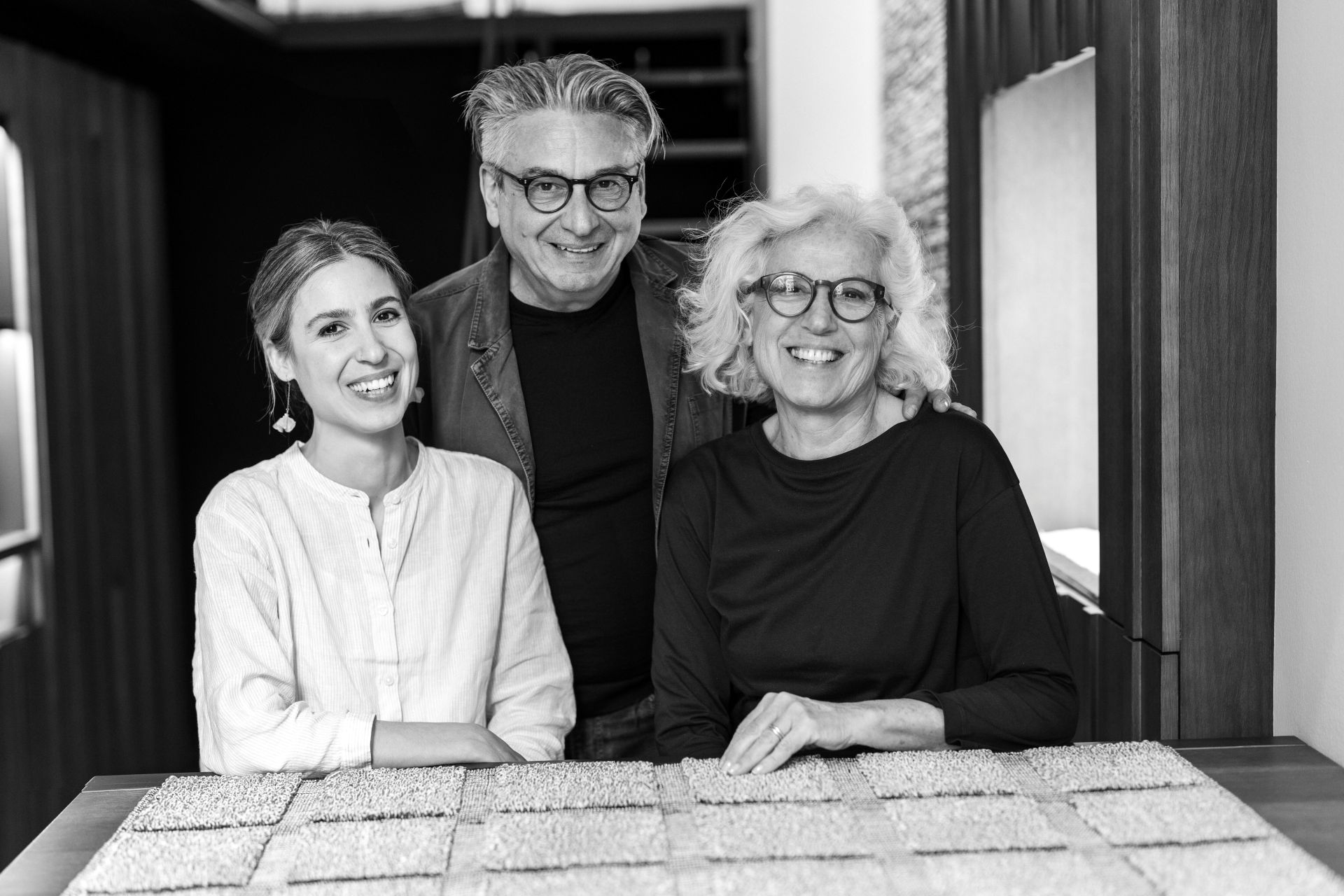
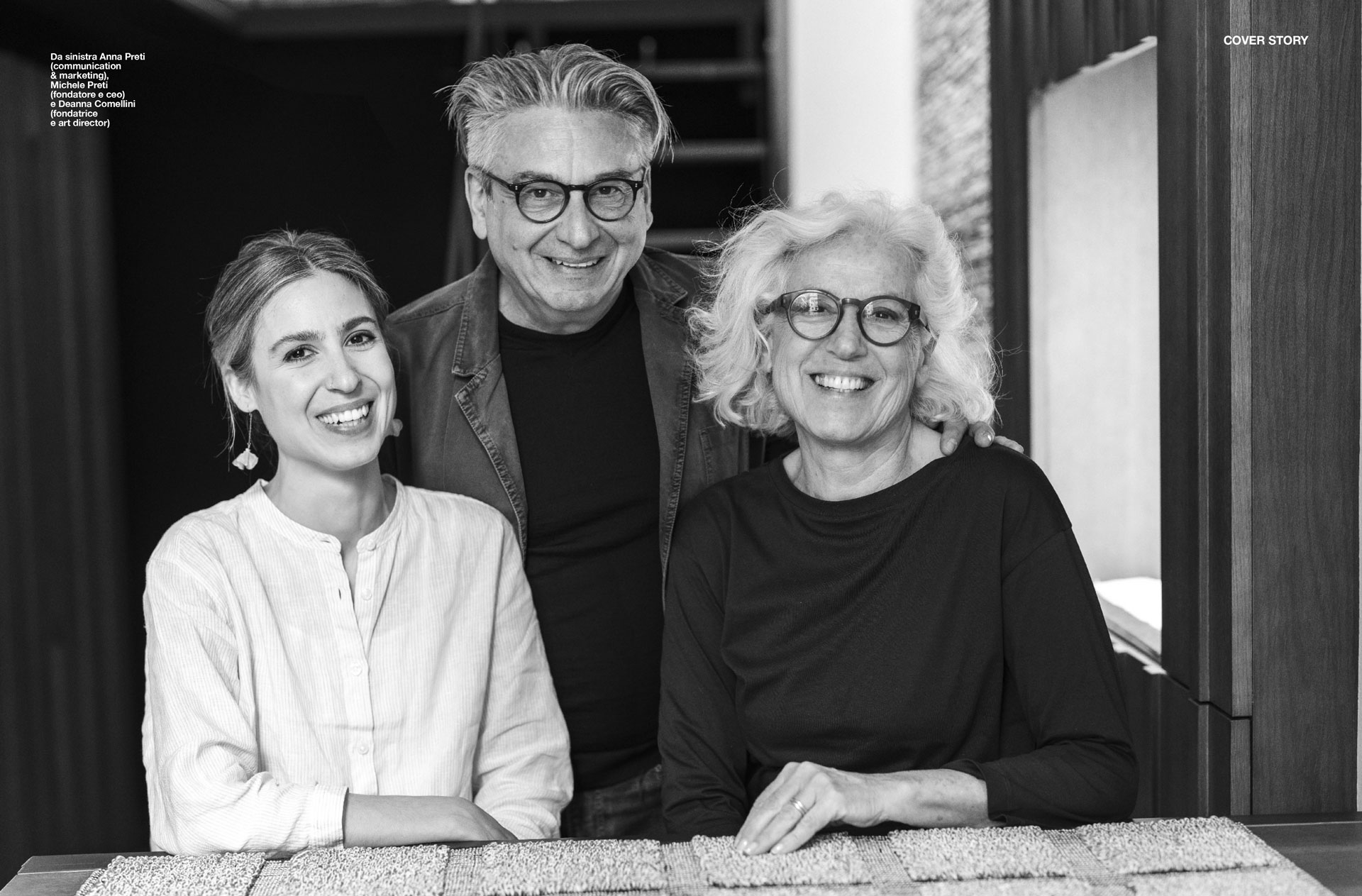
Anna Preti, Michele Preti, Deanna Comellini (photo Nicola Piccoli)